The Copper Water Guide
Everything you need to know about copper water — from safe use and care to copper science, craftsmanship and quality.
Aroveda Stories · Care Guide
Copper ages. That's how you know it's real.
Everything there is to know about copper water — what it is, the tradition and science behind it, how to use it safely, and how to clean and care for your bottle so it lasts a lifetime.
Pure, unlined copper. Handcrafted in India.
The Basics
What is copper water?
Copper water is drinking water that has been stored in a pure copper vessel long enough for a tiny, controlled amount of copper to dissolve into it.
When water sits in an unlined copper bottle for several hours, a very small quantity of copper ions migrates naturally into the water. The result is mineral-touched water with a characteristically smooth, soft taste — and a practice households across India have followed for generations.
Because Aroveda bottles are made from 99.96% pure, unlined and unlacquered copper, nothing stands between the metal and your water. What you pour is exactly what the copper gives it, and nothing else.
The Tradition
What is Tamra Jal?
Tamra Jal (ताम्र जल) is the Sanskrit name for “copper water” — water that has rested in a copper vessel, traditionally overnight.
In Ayurveda, water is poured into a clean copper vessel in the evening and left to stand for 6–8 hours. By morning it has become Tamra Jal, sipped on an empty stomach as part of a daily wellness ritual.
Ayurvedic texts describe Tamra Jal as helping to balance the body's three doshas — vata, pitta and kapha. However you view the tradition, the ritual is a simple, mindful way to begin the day with clean, copper-touched water.
From the Ayurvedic tradition
Storing water the way it was meant to be stored
In Ayurveda, water rested overnight in a pure copper vessel is called tamra jal — copper water. Fill your bottle before bed, let it sit 6–8 hours, and drink it first thing in the morning. Because Aroveda copper is unlined and unlacquered, nothing sits between the metal and your water.
A Long History
Why copper has been traditionally used
Long before modern water bottles, copper was the material of choice for storing and carrying water — in India, Egypt and across the ancient world.
In the Indian household, the copper lota and matka were everyday objects, valued because water kept in them stayed fresh and tasted clean. Ayurveda formalised the practice, recommending copper vessels for daily use. Three qualities kept copper in use for thousands of years:
Studied for its antimicrobial properties
Copper's oligodynamic effect helps keep stored water clean over several hours.
Ayurvedic tradition
Water stored overnight becomes tamra jal, prized in Ayurveda for daily wellness.
Plastic-free
One handcrafted bottle replaces hundreds of single-use plastic ones.
Built to last
99.96% pure, unlined copper can be renewed again and again — a lifetime bottle.
The Evidence
Copper water science
The tradition has a basis in science, too. Copper is naturally antimicrobial — an effect researchers call the oligodynamic effect.
Laboratory studies have found that storing water in copper vessels for several hours can significantly reduce common waterborne bacteria such as E. coli and other contaminants. The small amount of copper ions that dissolve into the water is what makes this possible.
Copper is also an essential trace mineral — your body needs small amounts of it for healthy connective tissue, iron absorption and normal enzyme function. Copper water offers a gentle, natural source.
Oligodynamic effect
Copper ions disrupt many bacteria, helping keep stored water cleaner.
Essential mineral
Copper supports iron absorption, enzymes and connective tissue.
Softer taste
Many people find copper-stored water tastes noticeably smoother.
Use It Right
Safe use
Copper is beneficial in the right amount — and like any mineral, it's about balance.
Store only plain, room-temperature water, and let it sit for 6–8 hours (overnight is ideal). There's no benefit to leaving water for days — empty, rinse and refill instead.
Aim for one to two bottles of copper water a day rather than drinking from it constantly. The World Health Organization's guideline for copper in drinking water is 2 mg per litre; water stored in copper for a few hours typically stays well below this.
Good to know
People with Wilson's disease or any condition affecting copper metabolism should avoid copper water. Never store acidic or carbonated drinks (citrus, soda, buttermilk) in copper, as they react with the metal. If you are pregnant or managing a health condition, check with your doctor first.
Copper's Life
Watch how copper changes — and comes back
Slide through the life of your bottle. Every stage is normal, and every stage is reversible with a natural clean. Drag to see how pure copper ages between washes.
Polished
Bright, rose-gold and faintly reflective. This is copper fresh from a clean — exactly how it should look after your weekly ritual.
The Cleaning Ritual
How to clean a copper water bottle
Copper responds to mild acid and gentle friction — the same ingredients used for generations. Never use commercial metal polish on the inside; anything you clean with touches your drinking water. Pick a method, then rinse well and dry completely.
- Halve a lemon and dip the cut face in coarse salt.
- Rub over the outside in small circles; the shine returns as you go.
- For the inside, add salt + lemon juice and swirl with the included brush.
- Rinse thoroughly with warm water and dry with a soft cloth.
- Soak a lump of tamarind in a little warm water to make a paste.
- Coat the copper, inside and out, and let it sit 2–3 minutes.
- Scrub gently with the brush or a soft cloth.
- Rinse until the water runs clear, then dry fully.
- Mix 1 tbsp salt + 1 tbsp flour + enough white vinegar for a paste.
- Spread over the tarnished areas and leave for 10 minutes.
- Buff off with a soft cloth — the paste lifts the oxide.
- Rinse well and dry with a lint-free towel.
A Simple Routine
How often to do what
Keep It Pure
Do & don't
Do
- Clean with natural acids — lemon, tamarind, or vinegar.
- Use the included soft brush for the narrow neck.
- Hand wash and dry with a soft, lint-free cloth.
- Store empty and dry with the cap loosely on.
- Fill with plain, room-temperature water for storing.
Don't
- Never put copper in the dishwasher — heat and detergent ruin it.
- Skip steel wool and abrasive scourers — they scratch the surface.
- Avoid bleach and harsh chemical cleaners.
- Don't store acidic or fizzy drinks (citrus, soda) inside.
- Don't leave very hot liquids or boil water in the bottle.
Everyday & Travel
Storing and carrying it well
Between uses
Keep it dry and uncapped in a cool spot. A little airflow prevents the trapped moisture that causes tarnish.
On the go
Carry it in the jute bag to protect the finish from scratches, and empty it before long storage.
Long breaks
Not using it for a while? Clean, dry fully, and store empty with the cap loose — a quick rinse revives it.
Quick Fixes
Troubleshooting copper
Every one of these is common and fixable — here's what's happening and what to do.
| What you see | What it means | What to do |
|---|---|---|
| Brown or black inside | Normal oxidation from water and air. | Clean with lemon & salt; it lifts off in minutes. |
| Green spots (patina) | Verdigris — harmless outside, best removed inside. | Rub with lemon & salt until the copper shows again. |
| Water tastes metallic | Water stored too long or acidic drink used. | Empty, clean, and store plain water for under a day. |
| Dull, patchy finish | Uneven tarnish or leftover cleaning residue. | Do a full lemon-salt clean, rinse well, dry completely. |
| White water spots outside | Hard-water mineral marks after drying. | Wipe with a cloth dampened in a little vinegar, then buff. |
Good to Know
Copper care FAQ
Is the dark tarnish inside safe to drink from?
How do I clean a copper water bottle naturally?
Why can't I use soap or the dishwasher?
My bottle turned green in one spot. Is that a problem?
How long can I keep water stored inside?
Can I put lemon water, juice, or fizzy drinks in it?
Made By Hand
Craftsmanship
Every Aroveda bottle is handmade in Moradabad — India's centuries-old centre of copper and brass craft, known as Peetal Nagri, the City of Metal.
Skilled artisans shape each bottle from pure copper, hand-hammering, joining and finishing it the traditional way. Because the work is done by hand, no two bottles are exactly alike — small variations are the signature of real craft, not a flaw.
There's no lining, no lacquer and no mixed metal — just solid, unalloyed copper, worked the way it has been for generations.
Proven Purity
Quality & testing
Purity you can verify. Not every “copper” bottle is what it claims — many use lacquer coatings or mixed metals that defeat the purpose.
Aroveda copper is independently tested, so you know exactly what you're drinking from.
- 99.96% pure copper, confirmed 99.96% pure copper (material test report available on request)by third-party SGS lab testing.
- BIS certified for quality and safety.
- No lacquer or internal coating — bare, food-safe copper.
- BIS licence CM/L 8700185822 under IS 17803:2022 before it ships.
Drink pure. Be sure.
Shop the copper bottleBuying guide
Questions buyers actually ask
Short, factual answers — with sources — so you can judge any copper bottle, including ours.
How can I identify a solid copper bottle?
Look inside, not outside. Solid copper shows the same reddish-gold metal on the inside wall, the neck threads and the base — with no silver, grey or glossy coating anywhere water touches.
- Check the interior. Shine a light inside. Bare copper looks matte rose-gold to brown. A silver or uniformly shiny interior means a steel liner or a lacquer coat.
- Watch it tarnish. Real, uncoated copper darkens within days of holding water and brightens again in seconds with lemon and salt. A bottle that never changes colour is almost certainly coated.
- Inspect the joints. Seams should be clean, smooth and the same colour as the body — not a grey bead of filler metal.
- Use a magnet — with care. Copper isn't magnetic, so a magnet that sticks reveals steel. Brass and aluminium aren't magnetic either, so a non-stick result alone doesn't prove copper.
- Ask for paperwork. A real maker can show a material composition report and a heavy-metal leaching test from an independent lab.
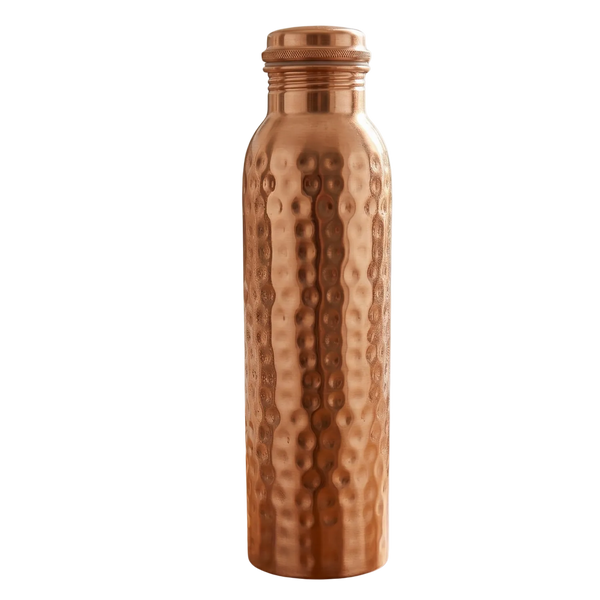
Our hammered 950 ml bottle is bare copper inside and out, so you can run every one of these checks yourself.
What does copper purity mean?
Purity is the percentage of the metal, by weight, that is copper. 99.9%+ is commercially pure copper; the remaining fraction is trace elements left from refining.
- Pure copper vs. alloys. Brass (copper + zinc) and bronze (copper + tin) can look similar but are different metals. They should not be sold as “pure copper.”
- Why it matters. High purity means fewer unknown elements in contact with your water and predictable cleaning and ageing behaviour.
- What purity doesn't tell you. A purity figure describes the sheet metal only — not the filler used in joints, the cap, or any coating. That is why a leaching test on the finished bottle, measuring what actually ends up in the water, matters as much as the purity number.
Aroveda bottles are made from 99.96% pure copper, per our material test report.
How do I clean and maintain a copper bottle?
Rinse after every use, dry fully with the cap off, and clean weekly with a mild natural acid (lemon, tamarind or vinegar) plus salt. No dishwasher, no steel wool, no chemical polish inside.
| When | What to do |
|---|---|
| After each use | Rinse with plain water; air-dry with the cap off. |
| Weekly | Lemon juice + salt inside; swirl and scrub with a narrow brush, then rinse well. |
| Heavy tarnish | Salt + flour + white vinegar paste for 10 minutes, then buff and rinse. |
| Always | Rinse away every trace of cleaning acid before refilling — acid left behind increases how much copper dissolves into water.5 |
Darkening is normal oxidation, not damage. Every Aroveda bottle ships with a narrow cleaning brush sized for the neck.
What should I know about copper exposure and safe use?
Copper is an essential nutrient, but more is not better. Store only plain water, keep storage to about a day, and stay well under recognised limits. Some people should not use copper vessels at all.
The reference numbers
- Daily need: 0.9 mg of copper for adults.1
- Daily upper limit: 10 mg from all sources combined — food, drinks and supplements.1
- Drinking-water limits: WHO guideline 2 mg per litre;2 US EPA action level 1.3 mg per litre.3
What a copper vessel adds. In a peer-reviewed study, water stored in copper pots for 16 hours contained about 0.18 mg of copper per litre — well within WHO limits.4 At that level, two litres a day adds roughly 0.35 mg, a small fraction of the 10 mg upper limit. Results vary: acidic water, warm water and longer storage all increase how much copper dissolves.5
Use it this way
- Plain, room-temperature water only — never juice, lemon water, soda, milk-based or hot drinks.
- Store 6–8 hours (overnight); empty and refresh within a day.
- If you take a copper supplement, count it toward the 10 mg limit.
Don't use copper vessels, or ask a doctor first, if:
- You have Wilson disease or any disorder of copper metabolism.6
- The water is for infants or for preparing infant formula.7
- You are pregnant, have liver or kidney disease, or are managing another health condition.
Nausea, stomach upset or a strong metallic taste are signs to stop, clean the bottle and shorten storage time.8
What is the difference between lined and unlined copper bottles?
In an unlined bottle, water touches copper. In a lined bottle, a stainless-steel or coated inner wall keeps water away from copper — effectively a steel or coated bottle with a copper exterior.
| Unlined (bare copper) | Lined / coated inside | |
|---|---|---|
| Water touches copper? | Yes | No |
| Traditional tamra jal? | Yes | No |
| Suitable drinks | Plain water only | Usually any drink (check maker) |
| Interior care | Weekly natural clean | Ordinary washing |
| Interior tarnishes? | Yes — normal and reversible | No |
Watch for the in-between case: clear lacquer sprayed inside to stop tarnish. It blocks contact with copper and can wear unevenly. If a “pure copper” bottle never tarnishes inside, ask whether it's lacquered.
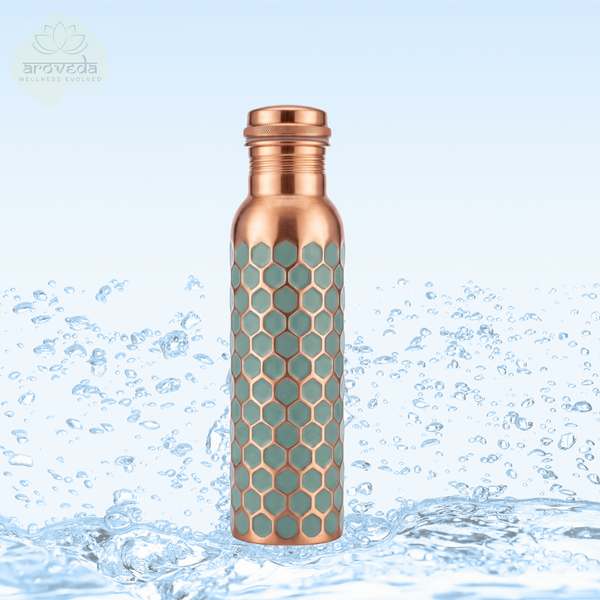
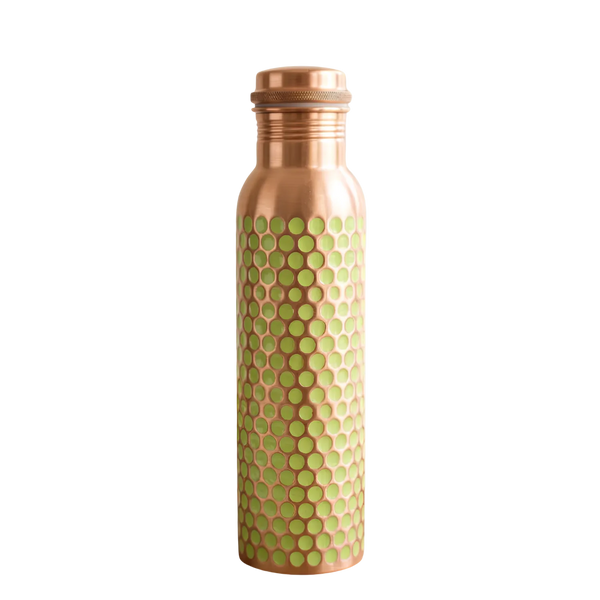
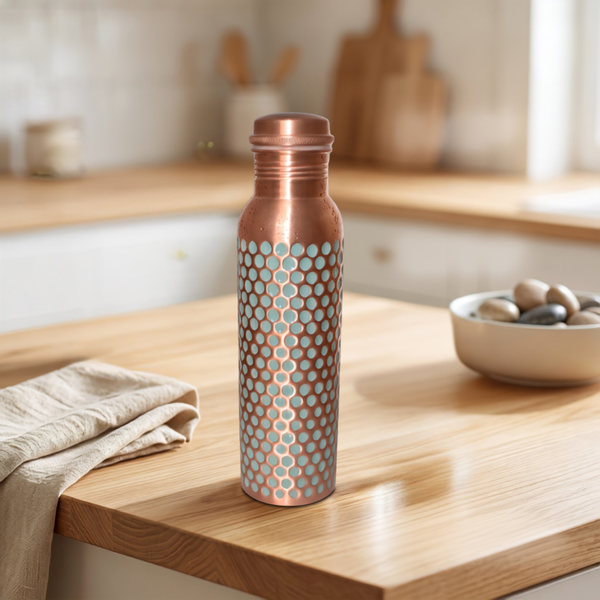
All Aroveda bottles are unlined. The enamel dots on our Aqua and Green bottles are decorative and on the outside only; the interior is bare copper.
What should I check before buying a copper bottle?
Confirm the metal, the interior, the joints and the paperwork — then make sure you can clean it.
- Material stated as a number — “99.9%+ pure copper,” not just “copper” or “copper-finish.”
- Unlined, uncoated interior — if copper water is the reason you're buying.
- Leaching test on the finished bottle for lead and cadmium from an independent, accredited lab. This is the single most useful document a seller can give you.
- Clean seams and a sound seal — smooth, same-colour joints and a food-grade silicone seal that doesn't leak.
- A neck you can clean — check that a brush is included or the opening is wide enough.
- Recognised certification. In India, copper drinking bottles fall under IS 17803:2022, and a BIS licence number on the product can be verified in the BIS Care app.9
- Clear safe-use instructions — a responsible seller tells you what not to store and who shouldn't use copper.
Aroveda bottles are BIS-licensed under IS 17803:2022 (licence CM/L 8700185822, held by Adroit India), unlined, and supplied with a cleaning brush.
This guide is general information, not medical advice. If you have a health condition, speak to your doctor before using copper vessels.
Sources
- NIH Office of Dietary Supplements. Copper — Fact Sheet for Health Professionals.
- World Health Organization. Guidelines for Drinking-water Quality, 4th ed. (copper guideline value 2 mg/L).
- US EPA. Lead and Copper Rule (copper action level 1.3 mg/L).
- Sudha VBP et al. Storing drinking-water in copper pots kills contaminating diarrhoeagenic bacteria. J Health Popul Nutr. 2012;30(1):17–21.
- National Research Council. Copper in Drinking Water. National Academies Press, 2000.
- NIDDK. Wilson Disease.
- Water Quality Association. Copper — Technical Fact Sheet.
- Health Canada. Copper in Drinking Water: Guideline Technical Document.
- Bureau of Indian Standards. IS 17803:2022 — Potable Water Bottles (Copper, Stainless Steel, Aluminium).
Our Bestsellers
Happy Customers
Drag to spin the ring


